Introductory price — today only

Digital book in PDF: it comes by email. Nothing is shipped on paper.

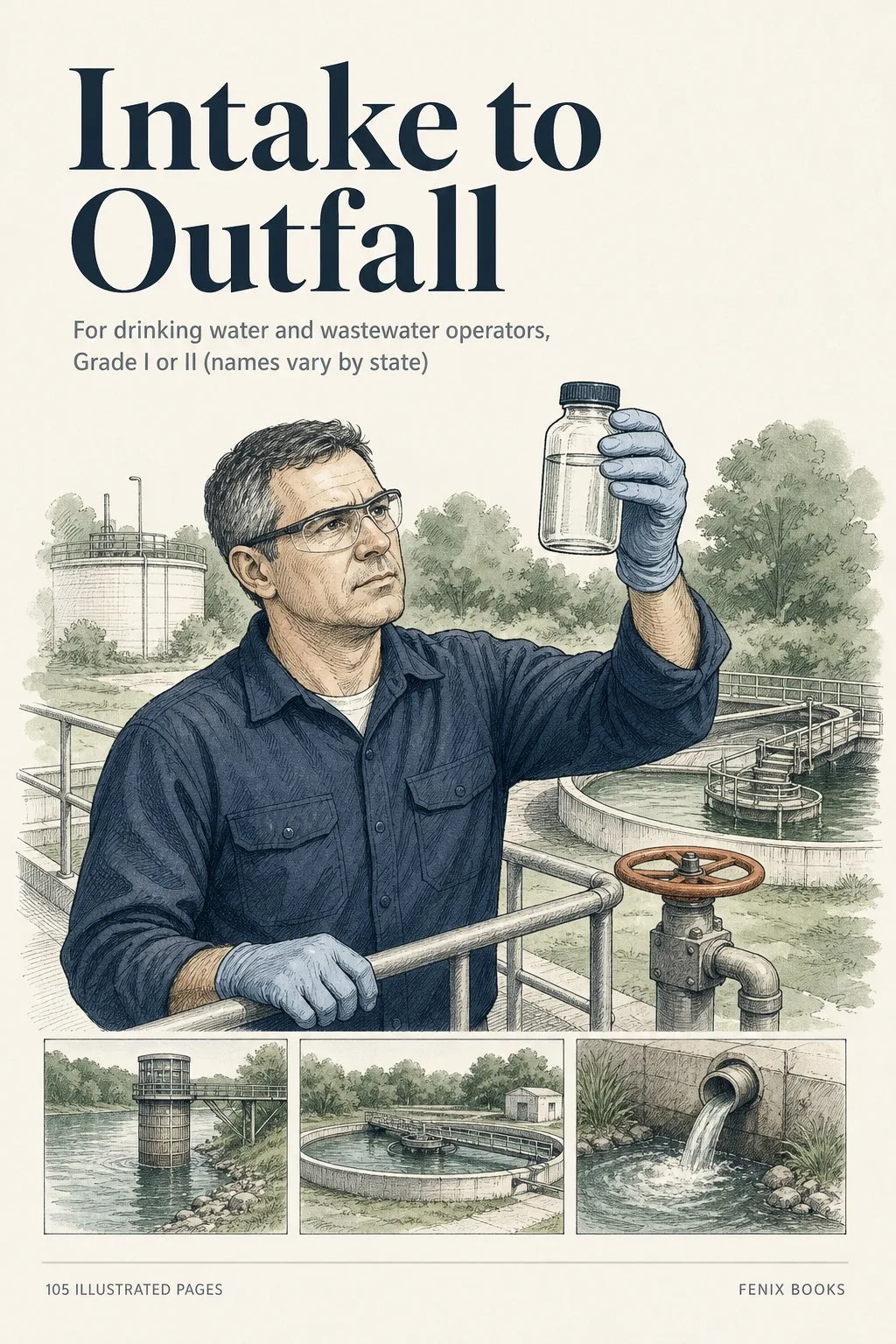
For water and wastewater operators, Grade I or II: know which number goes where, in the same 4 steps

Drinking water and wastewater treatment drawn page by page, with math worked in the same 4 steps. Grade names vary by state; drinking water and wastewater certifications are separate. Compare the contents with your state’s exam outline before buying. PDF by email; you can print it.

Get the book and two bonus books ➔

Protected checkout · PDF by email · 30-day guarantee

105illustrated topic pages
12sections covering both treatment systems
2included bonus books
PDFby email, printable

Take a look inside the book

Made to read on your phone on a break at the plant, or print and keep with your notes.

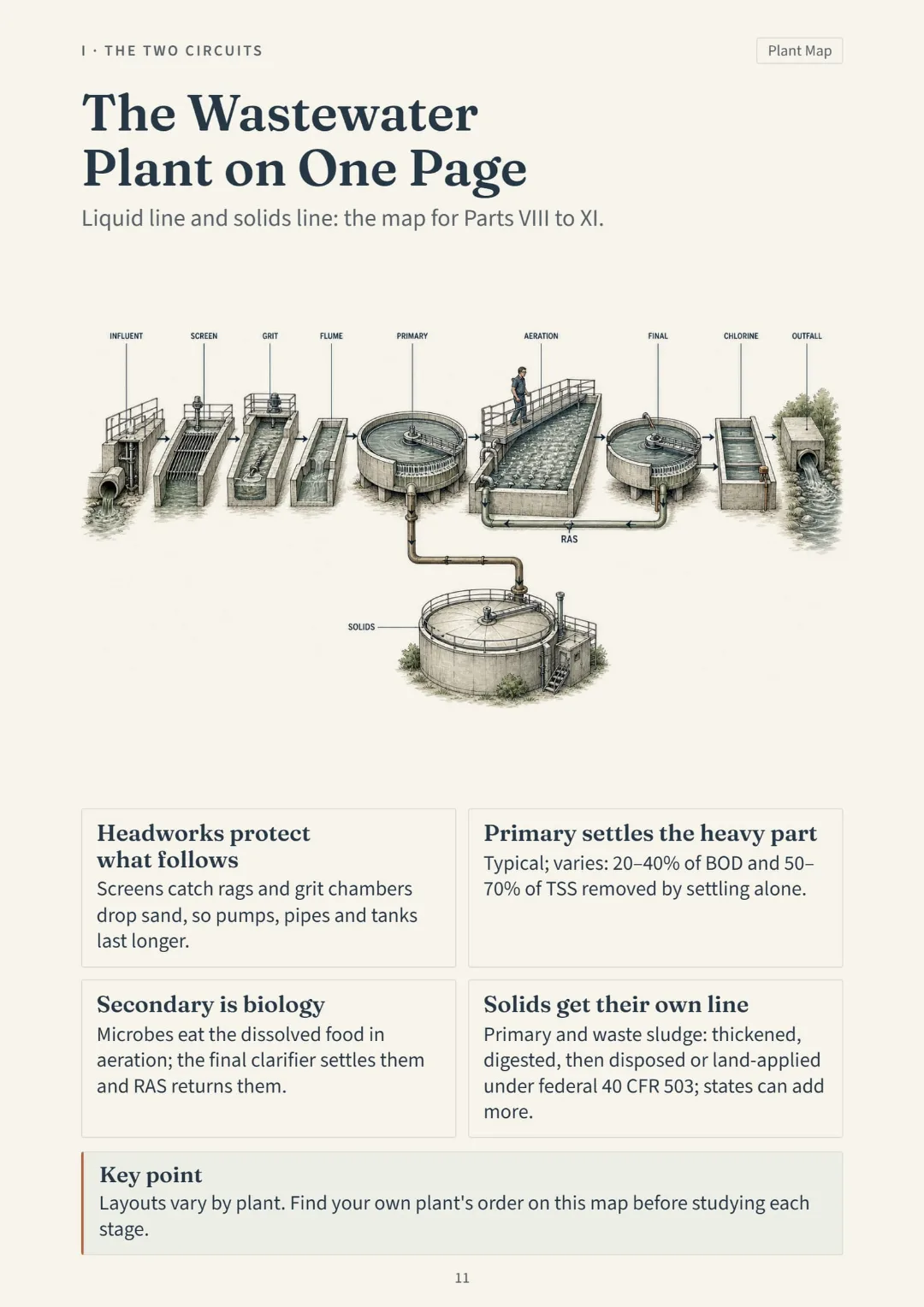
Wastewater plant in 9 stages, sewer to outfall, plus RAS and the solids line.
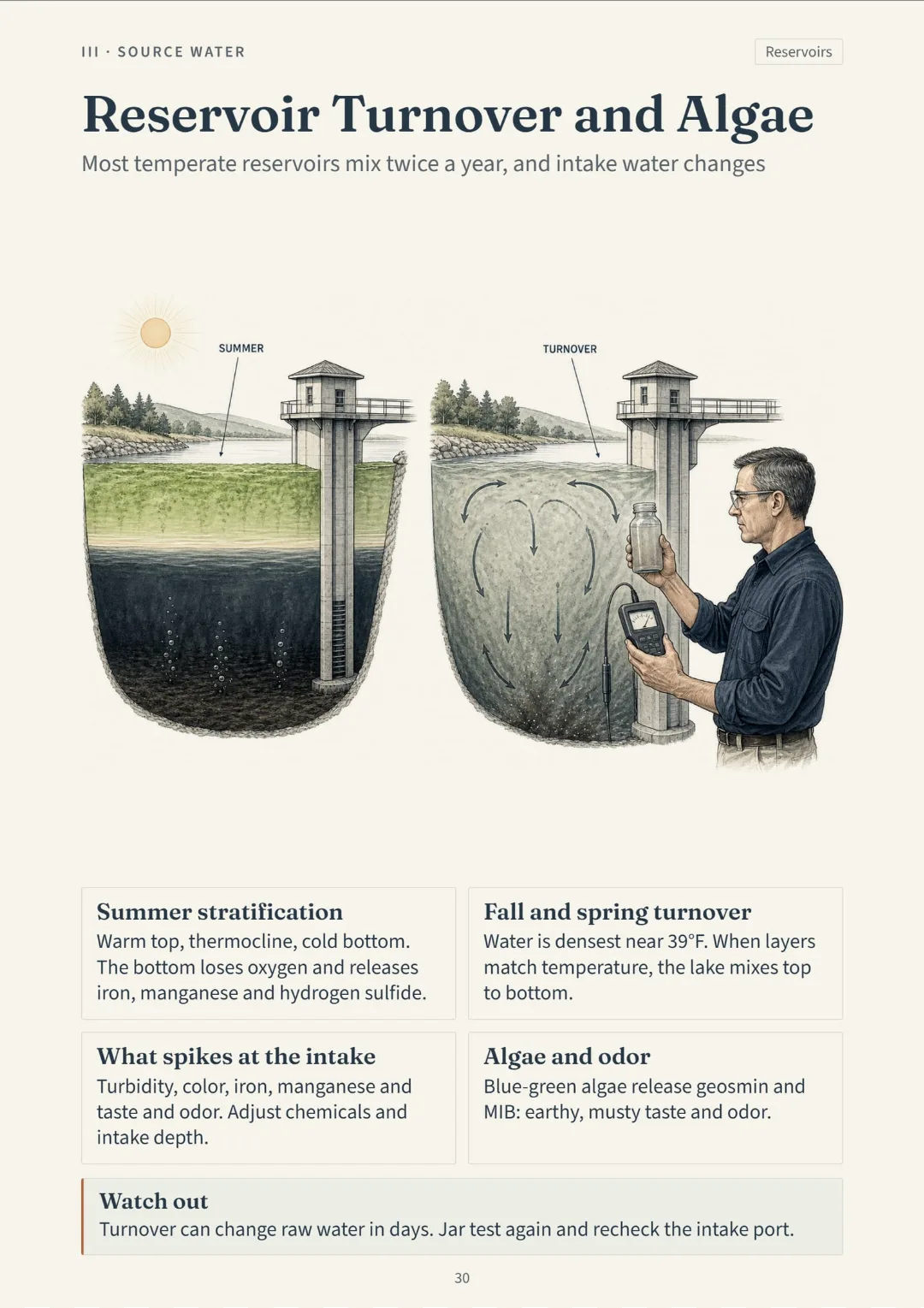
Stratified in summer, mixed in fall and spring: turbidity, iron, manganese and odor jump at turnover.
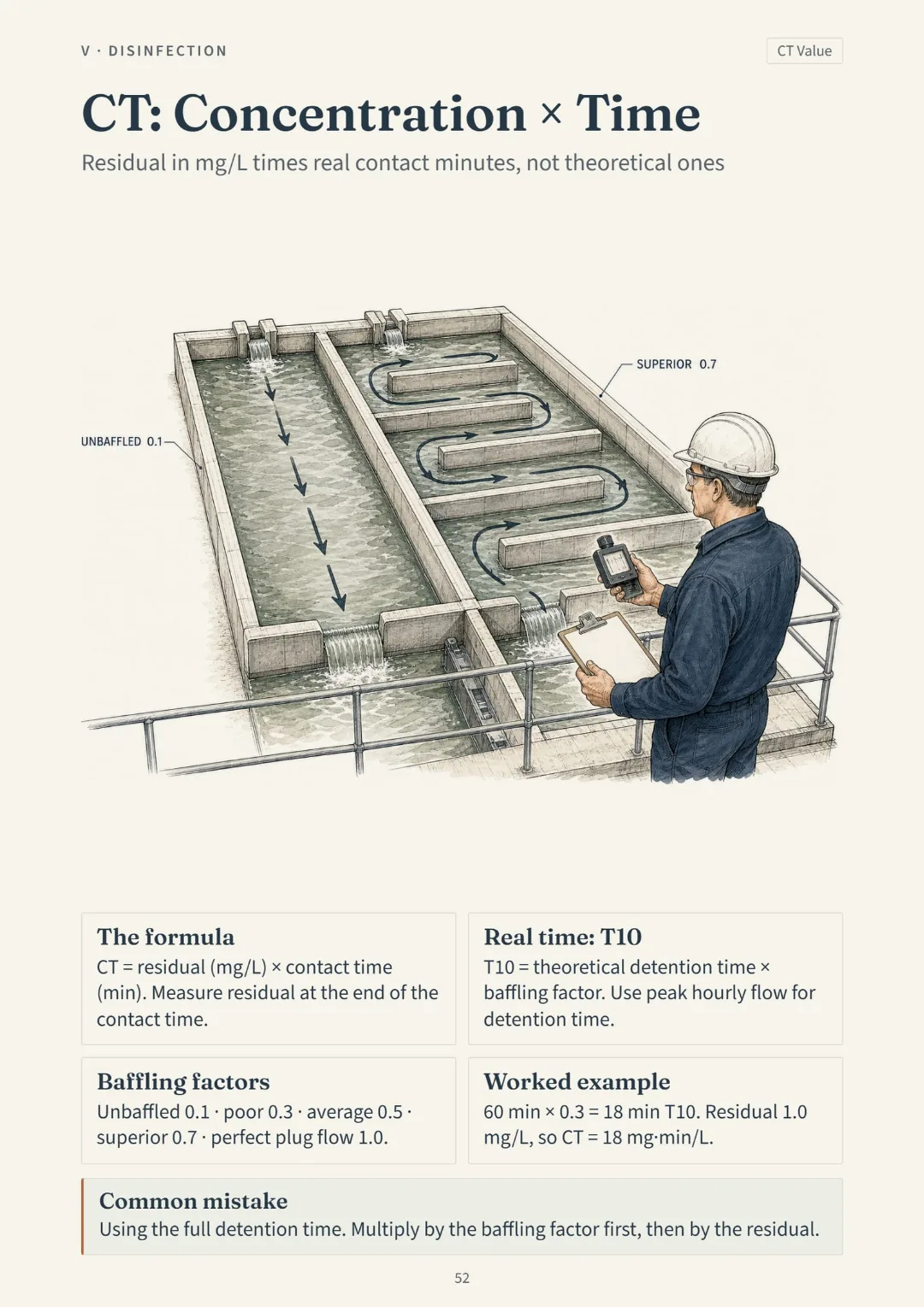
CT = mg/L × T10 minutes; T10 = detention time × baffling factor from 0.1 to 1.0.
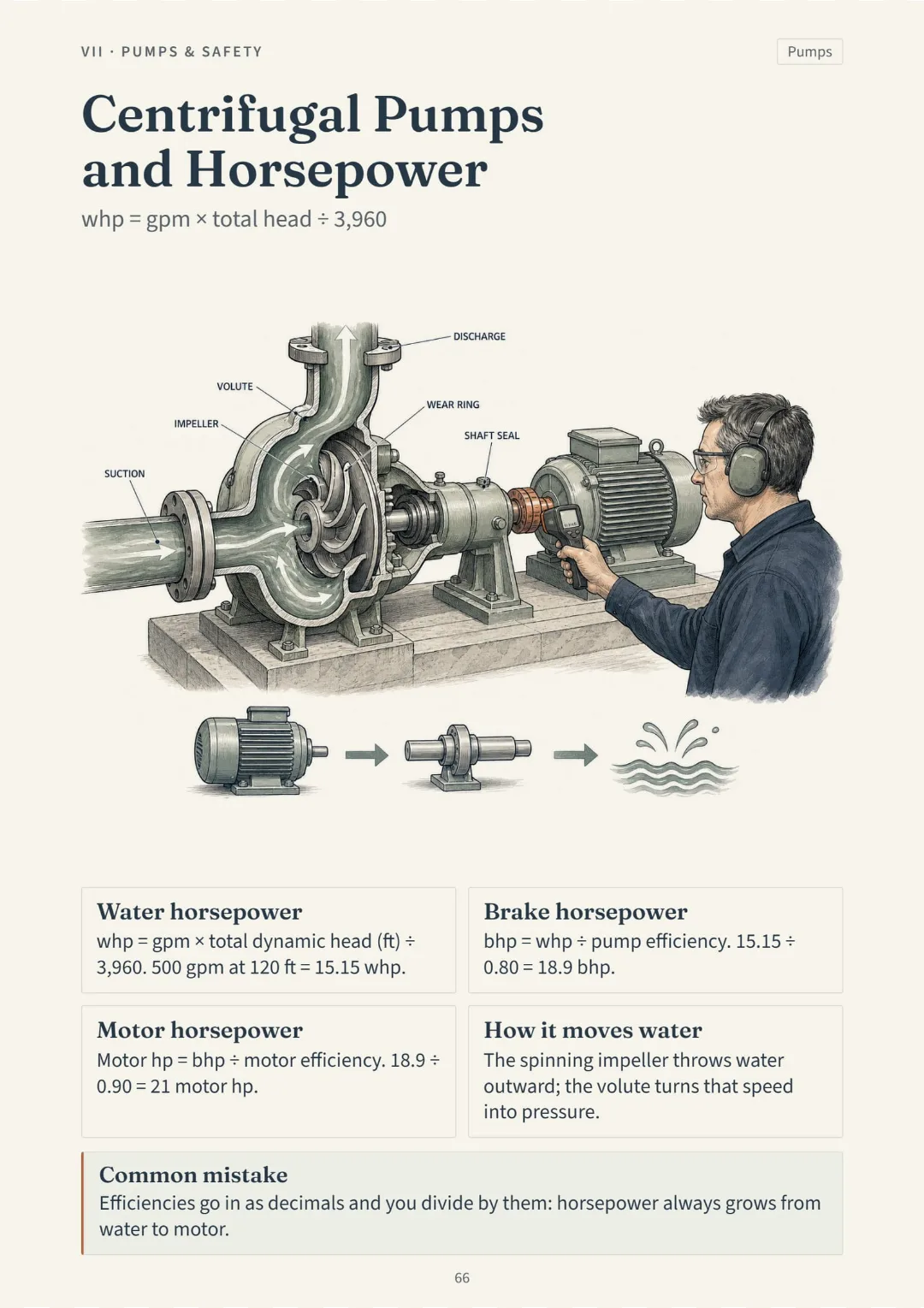
500 gpm × 120 ft ÷ 3,960 = 15.15 whp, then divide by pump and motor efficiency.
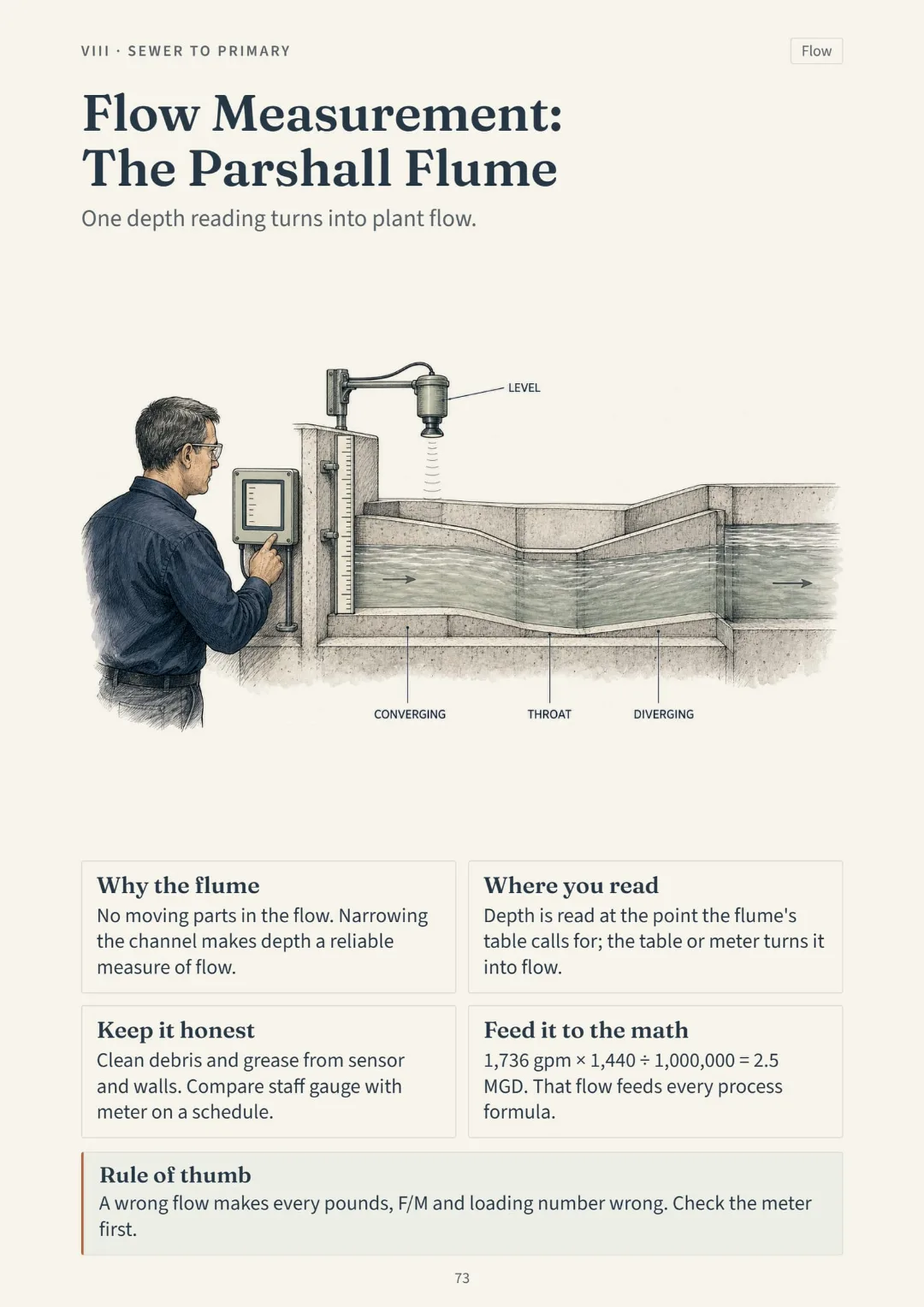
Parshall flume at free flow: one depth equals flow; 1,736 gpm × 1,440 ÷ 1,000,000 = 2.5 MGD.
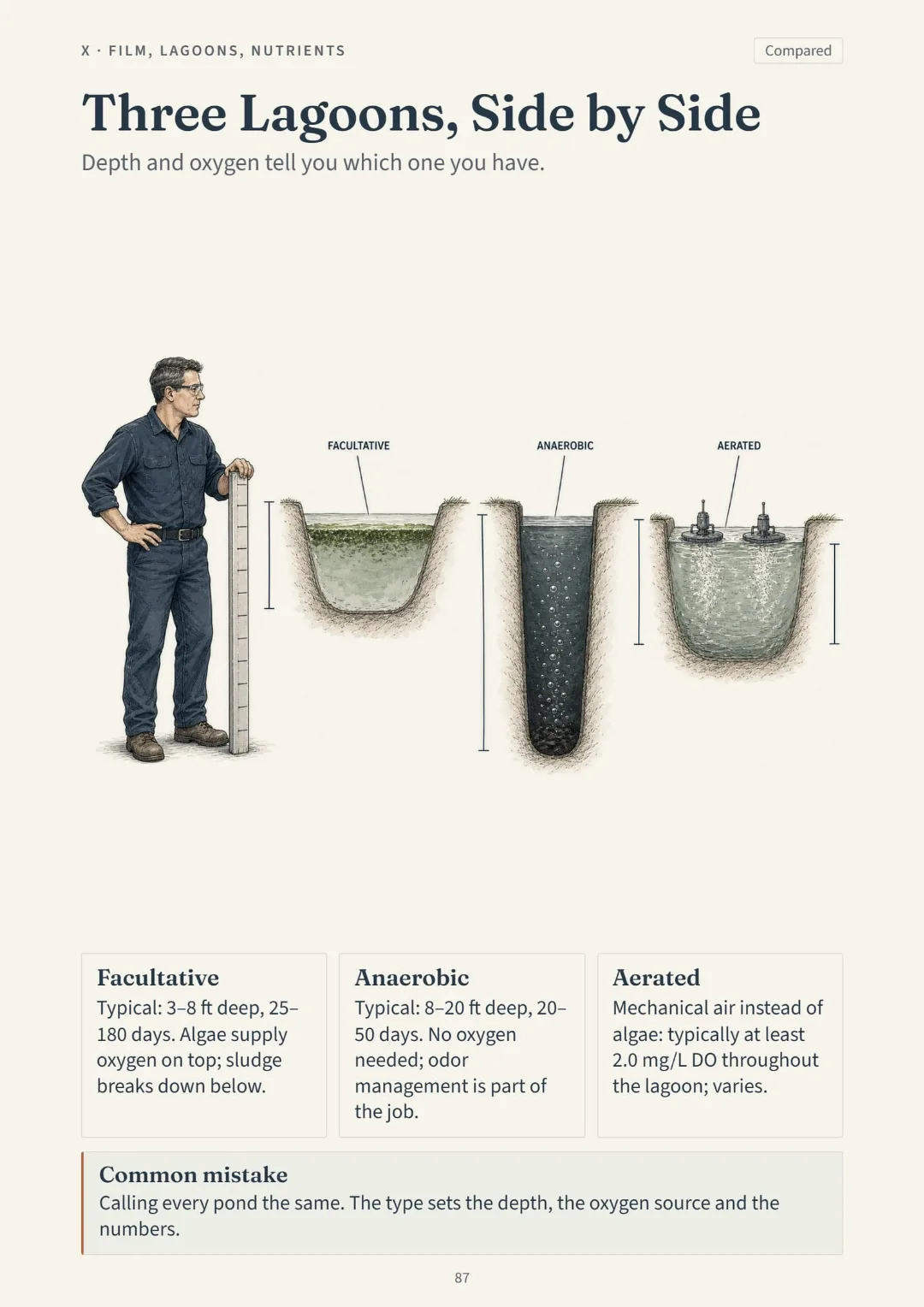
Facultative 3–8 ft, anaerobic 8–20 ft, aerated with at least 2.0 mg/L DO.
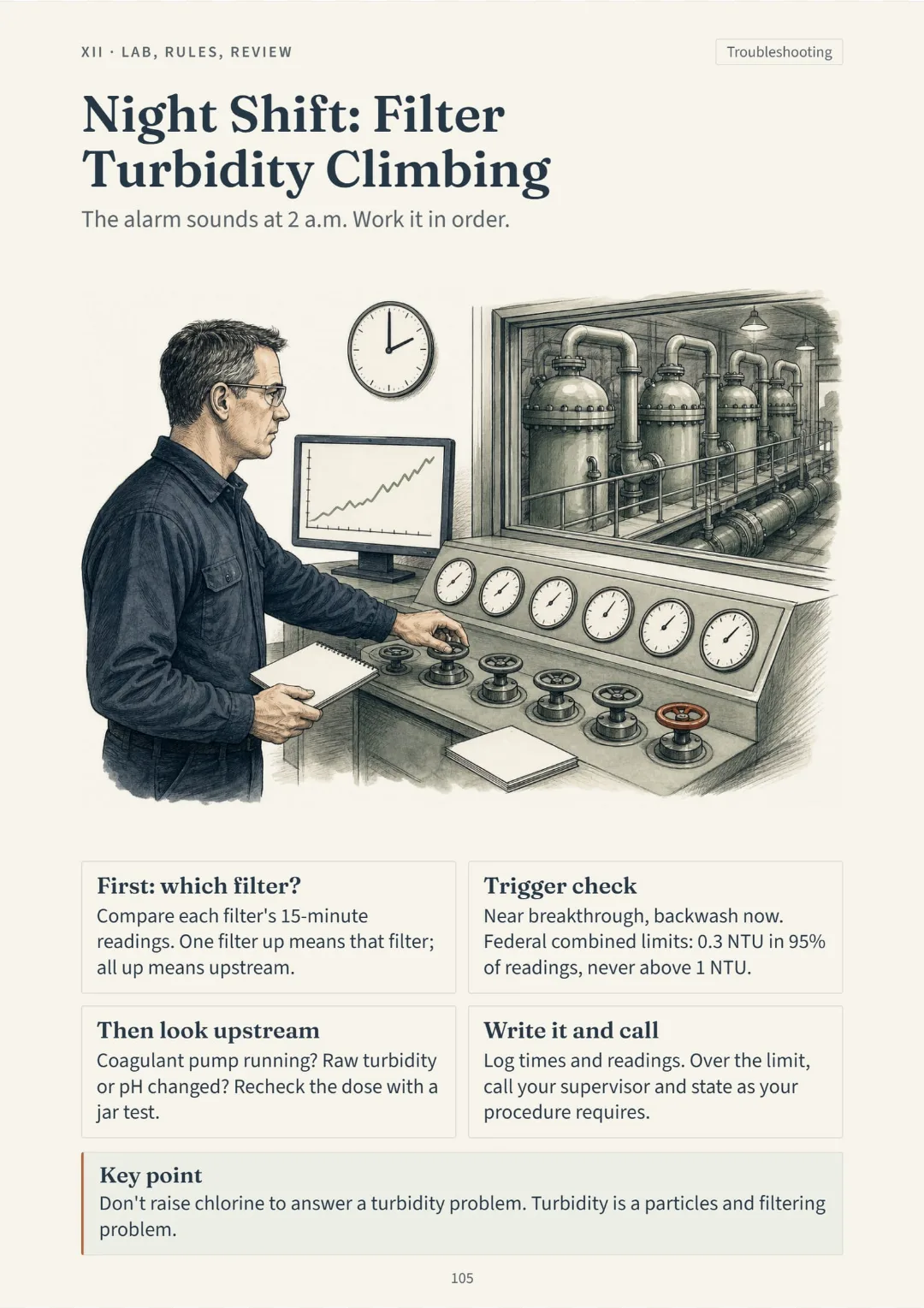
Turbidity climbing at 2 a.m.: which filter, backwash, coagulant, log; 0.3 and 1 NTU limits.

Swipe to see more · tap to zoom →

You have the formula. The missing link is the plant.

You sit down after your shift to study for the exam. The problem gives you gallons, minutes and a tank, and says: find the flow in MGD. You can find the formula, but you still have to decide which number goes where.

You work in wastewater, but your study book keeps showing drinking water filters. You need to see your own treatment process, including the return sludge and solids line.

Turbidity starts climbing at 2 a.m. and you are the only one on shift. You studied each rule on its own, but the clues do not connect when they show up together: which filter, when was the last backwash, what changed upstream.

Parshall flume at free flow: one depth equals flow; 1,736 gpm × 1,440 ÷ 1,000,000 = 2.5 MGD.

On the flume page, start with 1,736 gallons per minute. Multiply by 1,440 minutes per day to get gallons per day. Divide by 1,000,000 to express that flow in million gallons per day, or MGD. Rounded result: 2.5 MGD.

Pick the formula. Label the numbers. Convert the units. Solve. You can trace each step instead of holding it all in your head.

Give each number a place before you start.

COMPARE

The same topic, studied two ways

INSTEAD OF THIS
  • Start with a string of symbols.
  • Keep flow, head and efficiency in separate notes.
  • Check the answer without seeing how you got there.
Water horsepower represents the useful hydraulic output of a pump and equals capacity in gallons per minute times total dynamic head in feet, all divided by a constant that comes from thirty-three thousand foot-pounds per minute per horsepower divided by the weight of one gallon of water; the book draws a pump moving five hundred gpm against one hundred twenty feet of head and works through the result step by step, but the motor must also overcome friction in the pump casing and electrical losses in the windings, so brake horsepower divides the hydraulic result by pump efficiency expressed as a decimal, and motor horsepower divides again by motor efficiency, also as a decimal, requiring two values read from the problem and two efficiencies before a single answer appears.
CHOOSE THIS
  • Find flow and head on the pump drawing.
  • Work out water horsepower first.
  • Then account for pump and motor efficiency.
500 gpm × 120 ft ÷ 3,960 = 15.15 whp, then divide by pump and motor efficiency.
CONTENTS

Take a look: 12 parts, 105 topics

Follow drinking water from intake to tap, and wastewater from sewer to outfall. Math, pumps, safety and lab work connect the two.

IThe Two Circuits · pp. 7-14
  1. How to Use This Book
  2. Your Exam: Grades, Names and States
  3. The Two Circuits on One Map
  4. The Water Plant on One Page
  5. The Wastewater Plant on One Page
  6. Surface Water vs. Groundwater Systems
  7. Why We Treat: The Multiple-Barrier Idea
  8. What an Operator Actually Does in a Shift
IIOperator Math in 4 Steps · pp. 15-26
  1. How to Read a Math Problem
  2. The 4 Steps, Always in the Same Order
  3. Units and Conversions You Need
  4. Area of Rectangles and Circles
  5. Volume of Tanks, Basins and Pipes
  6. Flow: Q = A × V
  7. The Pounds Formula: mg/L × MGD × 8.34
  8. Percent Strength and Solution Feed
  9. Detention Time
  10. Pressure and Head: 2.31 and 0.433
  11. Percent Removal
  12. Surface Overflow and Weir Loading
IIISource Water and Pretreatment · pp. 27-33
  1. Watersheds, Reservoirs and Wells
  2. Source Water Protection
  3. Intakes, Screens and Grit
  4. Reservoir Turnover and Algae
  5. Pre-Oxidation and Taste and Odor
  6. Iron and Manganese Removal
  7. Well Basics: Casing, Screen and Drawdown
IVCoagulation, Settling and Filtration · pp. 34-47
  1. Why Particles Won't Settle on Their Own
  2. Coagulation: The Flash Mix
  3. Flocculation: The Slow Mix
  4. Coagulation vs. Flocculation, Side by Side
  5. Jar Testing to Pick the Dose
  6. Sedimentation Basins
  7. Sludge Handling
  8. Inside a Rapid Sand Filter
  9. Filter Loading Rate
  10. Detention Time vs. Filter Loading Rate
  11. Head Loss and When to Backwash
  12. The Backwash Sequence
  13. Turbidity: The Filter's Report Card
  14. Mudballs, Cracks and Air Binding
VDisinfecting Drinking Water · pp. 48-55
  1. Why We Disinfect: Pathogens in Three Groups
  2. Dose, Demand and Residual
  3. Free, Combined and Total Chlorine
  4. Breakpoint Chlorination
  5. CT: Concentration × Time
  6. Gas Chlorine vs. Hypochlorite
  7. Chlorine Gas Safety
  8. Residual Rules and Disinfection Byproducts
VIpH, Alkalinity, Hardness and Corrosion · pp. 56-62
  1. pH, Alkalinity and Hardness, Side by Side
  2. The pH Scale
  3. Alkalinity: The Water's Buffer
  4. Hardness: Calcium and Magnesium
  5. Softening: Lime and Ion Exchange
  6. Corrosion Control
  7. Fluoridation
VIIPumps, Distribution and Safety · pp. 63-69
  1. Storage Tanks and Pressure Zones
  2. Mains, Valves and Hydrants
  3. Cross-Connections and Backflow
  4. Centrifugal Pumps and Horsepower
  5. Pump Problems: Cavitation and Packing
  6. Lockout/Tagout and Confined Spaces
  7. H2S and Other Plant Gases
VIIIFrom the Sewer to the Primary · pp. 70-75
  1. Sewers and Lift Stations
  2. Bar Screens and Screenings
  3. Grit Removal
  4. Flow Measurement: The Parshall Flume
  5. Primary Clarifiers
  6. BOD, COD and TSS
IXActivated Sludge · pp. 76-84
  1. How Activated Sludge Works
  2. MLSS, RAS and WAS
  3. F/M: Food to Microorganisms
  4. Sludge Age
  5. How Much to Waste
  6. Settleability and SVI
  7. Reading the Microscope
  8. Bulking, Foam and Rising Sludge
  9. The Final Clarifier
XFixed Film, Lagoons and Nutrients · pp. 85-89
  1. Trickling Filters and RBCs
  2. Facultative Lagoons
  3. Three Lagoons, Side by Side
  4. Nitrification
  5. Denitrification and Biological Phosphorus
XIEffluent and Biosolids · pp. 90-98
  1. Secondary and Equivalent Limits
  2. Chlorinating and Dechlorinating Effluent
  3. UV Disinfection of Effluent
  4. E. coli 126: Criterion, Not Limit
  5. Anaerobic Digestion
  6. Class A vs. Class B Biosolids
  7. Biosolids Metals: Table 1 and Table 3
  8. Vector Attraction Reduction
  9. Class B Site Restrictions
XIILab, Rules and Review · pp. 99-111
  1. Sampling for Coliform Bacteria
  2. Lab Basics: Grab vs. Composite and Hold Times
  3. The Safe Drinking Water Act in One Page
  4. The Federal Rules, Mapped
  5. Lead and Copper Sampling
  6. Public Notification and Records
  7. Night Shift: Filter Turbidity Climbing
  8. Low Chlorine at the Far End
  9. Night Shift: Clumps in the Clarifier
  10. SVI Climbing, Effluent Cloudy
  11. The Formula Sheet, Drawn
  12. Math Mistakes That Cost Points
  13. Exam Day Checklist

See the plant before the terms.

See where each stage sits in the plant. Follow the flow arrows, then look at the return and solids lines. Each term stays tied to its spot in the plant.

Wastewater plant in 9 stages, sewer to outfall, plus RAS and the solids line.

The wastewater map shows nine stages from sewer to outfall, plus return activated sludge, or RAS, and the solids line.

You can follow the main flow and see which material comes back or leaves by another route.

Keep the drawing in view instead of memorizing the route.

What's inside Intake to Outfall

Ipp. 7-14

The Two Circuits

Find the drinking water and wastewater treatment routes, the main tasks in an operator’s shift, and what to check with your state about certification type, grade and exam requirements.

IIpp. 15-26

Operator Math in 4 Steps

Work through units, tank volume, flow, pounds, detention time and loading with the same four math steps.

IIIpp. 27-33

Source Water and Pretreatment

See how wells, reservoirs, intakes and pretreatment affect the water entering the plant.

IVpp. 34-47

Coagulation, Settling and Filtration

Follow flash mix, flocculation, settling, filtration and backwash through the drinking water plant.

Vpp. 48-55

Disinfecting Drinking Water

Separate chlorine dose, demand and residual, then work through breakpoint chlorination and CT.

VIpp. 56-62

pH, Alkalinity, Hardness and Corrosion

Tell pH, alkalinity and hardness apart, with drawings of softening and corrosion control.

VIIpp. 63-69

Pumps, Distribution and Safety

Connect pumps, pressure zones and backflow with lockout/tagout, confined spaces and plant gases.

VIIIpp. 70-75

From the Sewer to the Primary

Trace wastewater through sewers, lift stations, screens, grit removal and primary settling.

IXpp. 76-84

Activated Sludge

Follow the solids through activated sludge and the final clarifier. Connect mixed liquor suspended solids (MLSS), return sludge (RAS) and waste sludge (WAS), then review the food-to-microorganism ratio (F/M), sludge age and sludge volume index (SVI).

Xpp. 85-89

Fixed Film, Lagoons and Nutrients

Compare fixed-film systems and lagoons, then follow nitrogen and phosphorus removal.

XIpp. 90-98

Effluent and Biosolids

Separate effluent rules from permit limits and compare digestion, biosolids classes and metals tables.

XIIpp. 99-111

Lab, Rules and Review

Review sampling, federal rules, night-shift study scenes, formula checks and exam-day planning.

Plus, 2 free books come with it

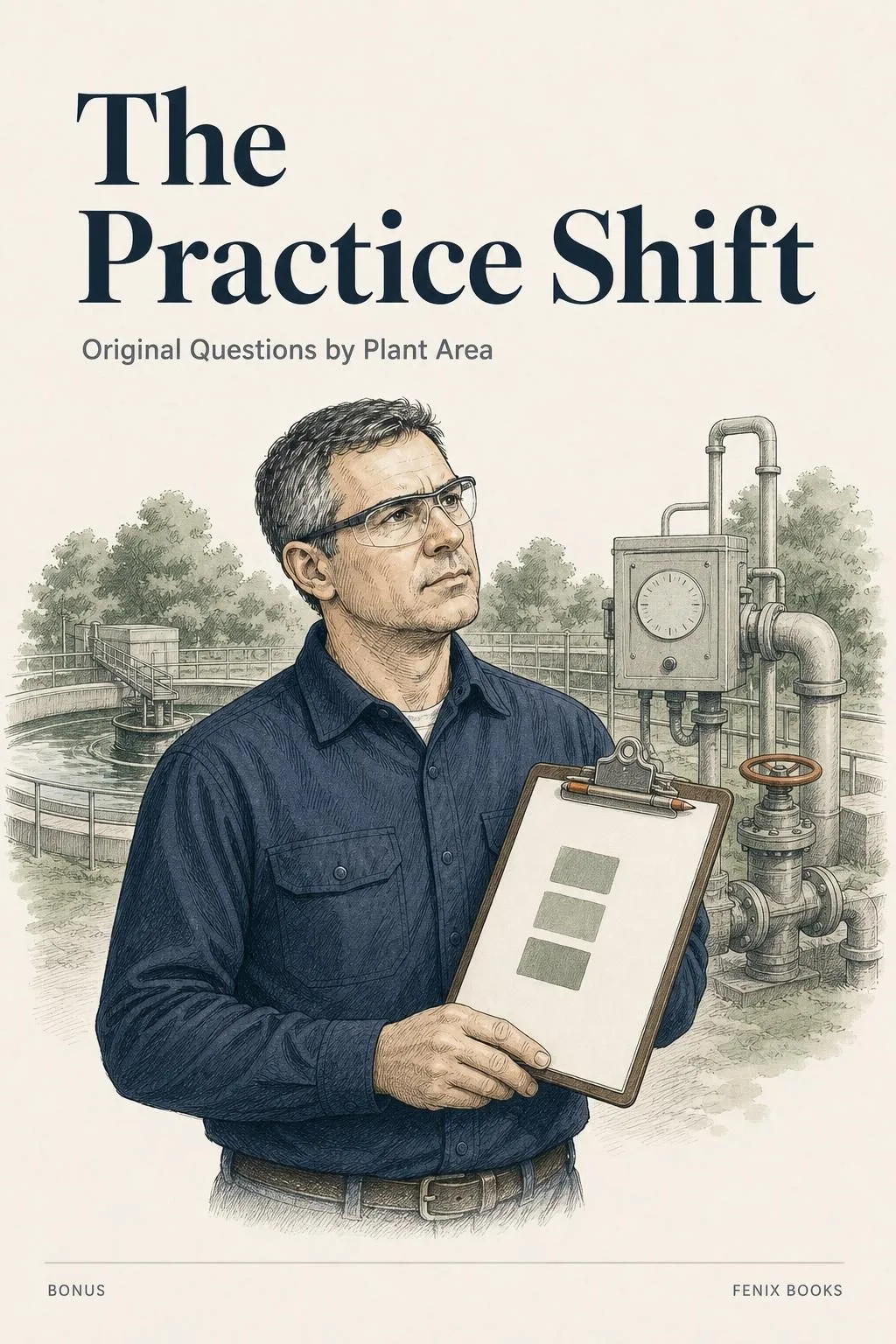
The Practice Shift: Original Questions by Plant Area

GIFT 1: «The Practice Shift: Original Questions by Plant Area»

Bought separately: US$ 17.90

Check yourself area by area with original practice questions, on both circuits, with each answer explained right underneath.

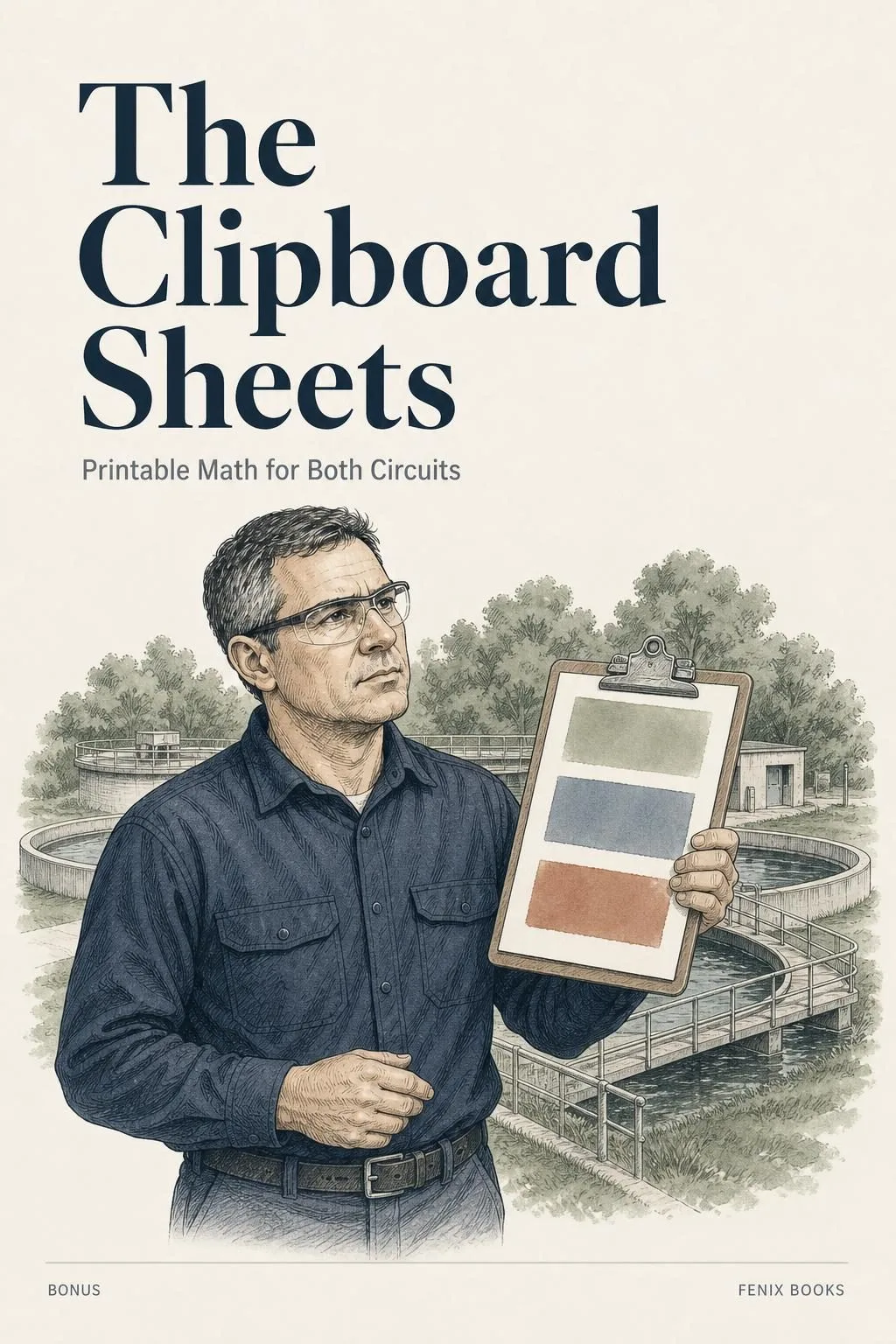
The Clipboard Sheets: Printable Math for Both Circuits

GIFT 2: «The Clipboard Sheets: Printable Math for Both Circuits»

Bought separately: US$ 14.90

Print the formulas and conversions you use most, sorted by circuit, and keep them on the clipboard while you study or work.

Your bundle: Intake to Outfall and 2 gifts

  • Intake to Outfall: 105 illustrated pagesUS$ 63
  • GIFT 1: The Practice Shift: Original Questions by Plant AreaUS$ 17.90
  • GIFT 2: The Clipboard Sheets: Printable Math for Both CircuitsUS$ 14.90
  • High-quality PDF file, ready to printIncluded
Total value US$ 95.80
BUNDLE PRICE
US$ 27
YOU SAVE: US$ 68.80
GET INTAKE TO OUTFALL · US$ 27

Digital book in PDF: it comes by email. Nothing is shipped on paper.

Protected paymentEncrypted data30-day guarantee

PDF by email: You receive Intake to Outfall as a PDF in your inbox, along with the 2 free books. You pay once: no installments, no extra charges.

Does this fit your next step?

You’re studying after years away

You’re studying after years away

You know tools and equipment, but school math feels far away. Start with units and follow the same four steps.

You work in wastewater

You work in wastewater

You need more than drinking water notes. Follow the wastewater treatment process through activated sludge, clarifiers, effluent and biosolids.

You already run the plant

You already run the plant

New hires often inherit scattered training notes. Print the pages, keep a set in the locker room or control room, and point to the drawing when you explain the route. It works alongside your plant’s own training and procedures.

Everything your purchase includes

US$ 95.80US$ 27
GET INTAKE TO OUTFALL · US$ 27

Digital book in PDF: it comes by email. Nothing is shipped on paper.

30DAYS
GUARANTEE

30 days to try it

100% money-back guarantee for 30 days. Try it with the plant topics and math you need to study. If it doesn’t save you time or clear up your question, tell us what didn’t work and we’ll refund 100%.

Common questions

Is this a printed book or a digital book?

It’s a digital book: PDF by email. Both bonus books are PDFs too. You can print them.

Can I read it on my phone?

Yes. Each topic has its own page, and you can zoom in on any drawing or formula. You can also read the PDFs on a tablet or computer.

Will it help if I haven’t done math in years?

The book starts with reading a problem, units and conversions, then uses the same four steps in its worked examples. Before buying, look at the sample math pages shown here to judge the starting level and how each step is explained. It is an operator study guide, not a complete basic math course.

How do I receive the material?

The book and both bonus books are sent as PDFs to the email address you enter at checkout.

Does it fit my state’s operator exam?

It is a general U.S. study aid, not a state-specific exam course. Before buying, get the current exam outline from your state’s operator certification agency. Check the certification type—drinking water treatment, distribution, wastewater treatment or collection—and your grade or class. Then compare its required topics with the full contents shown here. Grade I and II labels are not equivalent in every state. Drinking water, wastewater, distribution and collection certifications are usually separate, and this book does not cover every state exam.

How much of the book is wastewater?

Four of the 12 parts are wastewater only: collection, headworks, primary treatment, activated sludge, lagoons, nutrients, effluent and biosolids. Math, lab and safety topics are shared.

Is this an official exam guide?

No. This is an independent, unofficial study guide. Buying or completing it does not award an operator certificate or continuing education credit. Certification requirements are set by your state. The guide is not affiliated with or endorsed by WPI, ABC, AWWA, WEF or the EPA. Practice questions are original, not official exam questions.

Does it replace training or plant procedures?

No. It supports study and review. It does not replace required training, supervised practice, your plant’s procedures, your permit or directions from qualified staff.

Can I use it to help train a new hire?

Yes. Print the pages you need and go through them together: follow the plant on the drawing, then work the math in the same 4 steps. Instead of a stack of scattered notes, the next hire has one route to follow. It adds to your plant’s training and procedures; it doesn’t replace them.

Is this a one-time payment?

Yes. The book and two included bonus books are a one-time purchase, with no subscription.

Where do the numbers in the book come from?

Federal rules and limits are cited from EPA 40 CFR Parts 141, 143, 133, 136 and 503 and OSHA 29 CFR 1910.146, 1910.147 and 1910.1000, and are labeled federal in the book. Formulas and typical operating ranges come from state training manuals and EPA fact sheets; ranges are labeled as ranges, not rules. Your state, your permit and your plant may have stricter requirements.
Before you close this page

You can return to the same steps when the numbers start to blur.

You can point to the drawing when you need to explain how you got there.

You can keep a clear study reference beside the notes you already use.

You already bring years of work to the page. Give yourself a clear way to connect the plant and the math.

US$ 27, paid once · 30-day guarantee · PDF by email

GET INTAKE TO OUTFALL · US$ 27

Digital book in PDF: it comes by email. Nothing is shipped on paper.